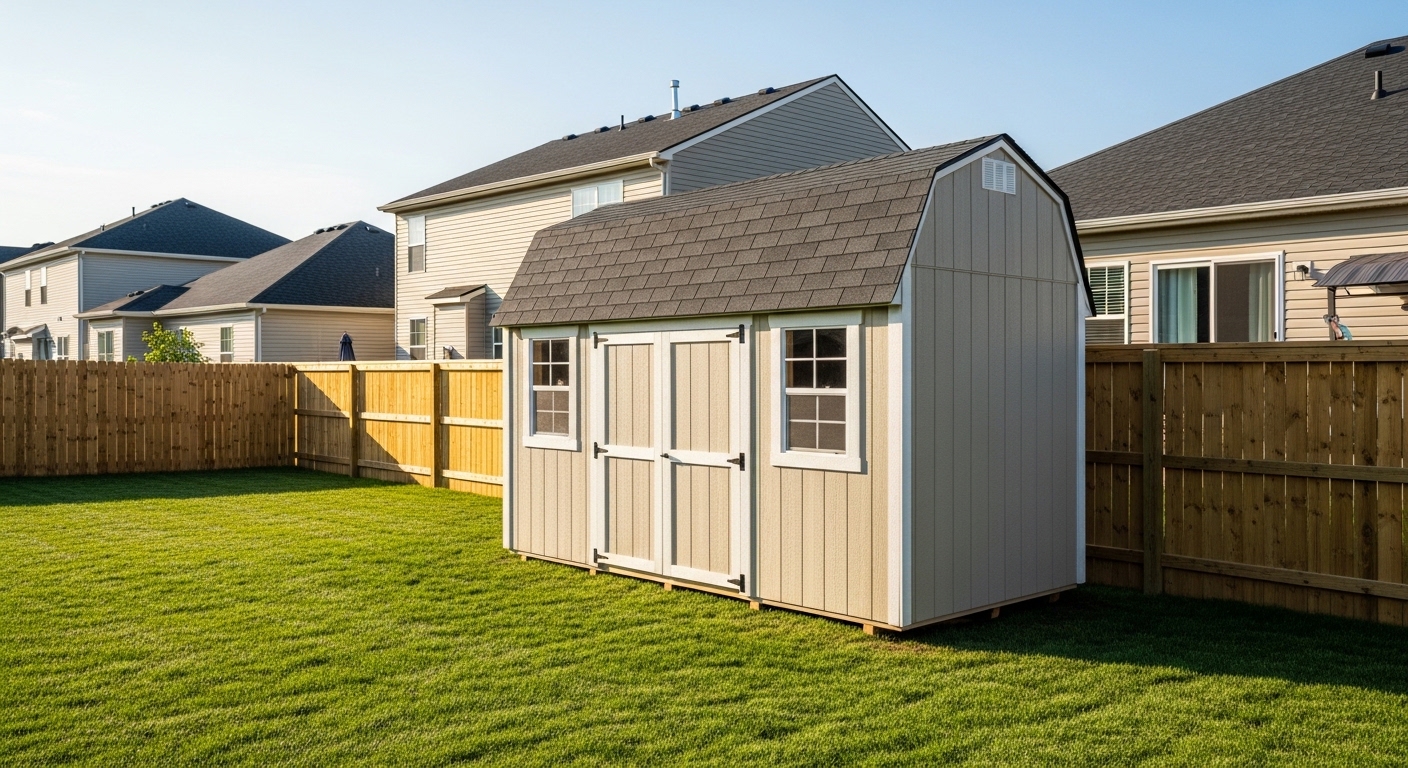
You've got the backyard space. You've got the project in mind — extra storage, a workshop, a covered carport, maybe even a home office. But there's one thing standing between you and breaking ground: your HOA.
If you live in one of San Antonio's many HOA-governed neighborhoods — or anywhere in the surrounding Hill Country communities of Boerne, New Braunfels, Bulverde, or Spring Branch — there's a good chance your homeowners association has something to say about what gets built in your backyard. And if you skip that conversation, you could be looking at fines, a forced tear-down, or a very uncomfortable call from your HOA board.
The good news: most HOAs do approve backyard structures. The key is knowing what they're looking for — and building a shed that makes the approval process as smooth as possible.
HOA Rules Are Separate From City or County Permits
This is the first thing most homeowners don't realize: your HOA and your city building department are two completely different entities, and they operate independently. Getting a city permit doesn't mean your HOA approves the project. Getting HOA approval doesn't eliminate the need for a city permit if one is required.
You need to clear both hurdles. And in some HOA-governed communities, the HOA's standards are actually stricter than what the city requires — particularly when it comes to appearance and materials.
Important: Building without HOA approval — even with a valid city permit — is a violation of your CC&Rs (Covenants, Conditions & Restrictions). The HOA can require you to remove or modify the structure at your expense, and violations can affect your ability to sell your home.
What Most San Antonio HOAs Are Looking For
HOA architectural review standards vary from community to community, but after years of building custom structures across the Greater San Antonio area, we've seen a consistent set of factors that come up in most HOA reviews.
Common HOA Review Criteria for Backyard Structures
- Size and square footage — many HOAs cap the maximum footprint or height of accessory structures
- Placement and setbacks — most require the structure to be a certain distance from property lines, fences, and the main home
- Roofing materials — shingles that match or complement the main home are commonly required; metal, plastic, or roll roofing may not be permitted
- Exterior finish — painted wood, LP SmartSide, or Hardie-type materials that coordinate with the home's existing colors are typically preferred
- Overall appearance — many HOAs want the structure to look like a natural extension of the property, not a prefab box dropped in the yard
- Visibility from the street — some communities restrict structures that are visible from the front of the home or require screening
The theme running through all of these requirements is the same: your HOA wants the structure to look like it belongs there. They're protecting property values across the entire community, and a structure that looks out of place — mismatched materials, wrong colors, wrong style — is exactly what they're trying to prevent.
Why a Custom-Built Shed Gets Approved More Easily Than a Prefab
Walk through any big box store or browse prefab shed websites and you'll find plenty of options that are cheap, fast, and generic. They come in standard sizes, standard colors, and standard materials — none of which are likely to match your specific home.
When you submit a prefab shed application to your HOA's architectural review committee, they're looking at a product that was designed to fit anywhere, which usually means it won't look like it belongs anywhere specific. That's a much harder sell.
A custom-built shed from J.B. Woolf is a different conversation entirely. We build to your specifications and your property. We can match your home's roofline pitch, use complementary siding materials, and paint or stain the structure to coordinate with your existing exterior colors. When your HOA looks at your application, they're seeing a structure that was clearly designed with their standards in mind — and that makes approvals faster and smoother.
Custom = HOA-Friendly. A shed built to match your home's roofline, siding, and color palette checks every box HOA architectural committees are trained to look for. It's not just better-looking — it's a smarter strategy for getting your project approved quickly.
The HOA Approval Process: What to Expect
Every HOA is different, but the general process for getting a backyard structure approved tends to follow a similar path across most San Antonio-area communities.
Step 1: Review Your CC&Rs
Your CC&Rs — the Covenants, Conditions & Restrictions that govern your community — are your starting point. These documents outline the rules for what's allowed, what's restricted, and what requires approval. If you don't have a copy, your HOA management company can provide one. Look specifically for sections on accessory structures, outbuildings, or improvements.
Step 2: Request the Architectural Review Application
Most HOAs have a formal application process for any exterior change or addition to your property. This typically involves submitting a written request with details about the project — dimensions, materials, placement, colors, and sometimes a site diagram showing where the structure will be located on your lot.
Step 3: Submit Detailed Plans
The more detail you provide, the faster your application typically moves. A vague submission — "I want to build a 12x16 shed" — gives the committee less to work with and more reason to ask follow-up questions. A complete submission with material specifications, color samples, and a site plan gives them everything they need to make a decision.
Step 4: Wait for Written Approval
Most HOA architectural review committees meet on a set schedule — monthly is common. Turnaround times vary, but having a complete application in the first submission significantly reduces back-and-forth. Once you receive written approval, keep a copy — you'll want it for your records and potentially for your city permit application as well.
Never start construction before receiving written HOA approval. Verbal approvals, informal conversations with a board member, or "pretty sure it'll be fine" assumptions are not substitutes for written authorization. Build first and ask forgiveness later is a very expensive lesson in HOA communities.
HOA-Governed Communities We Commonly Build In
We've built custom sheds, carports, garages, and outdoor structures in HOA neighborhoods across the San Antonio metro and surrounding Hill Country. If you're in a community with architectural review requirements, we've almost certainly worked through that process in your area before.
Communities we regularly serve include neighborhoods throughout San Antonio proper, as well as HOA-governed developments in Boerne, New Braunfels, Helotes, Bulverde, Spring Branch, Canyon Lake, and Leon Valley. Every community is a little different — but the fundamentals of building something that earns approval are the same everywhere.
Our Free On-Site Estimate Helps You Walk In Prepared
Before you sit down to fill out an HOA application, it helps to know exactly what you're proposing. That's one of the biggest values of our free on-site estimate: you leave the conversation knowing the size, placement, materials, colors, and general design of what you want to build — which is exactly what your HOA needs to see.
We've worked through the HOA process alongside enough clients to know what committees typically want and how to present a project in the most favorable light. We're not your HOA liaison — but we can help you put together an application that gives your project the best possible shot at a quick, clean approval.
What Our On-Site Visit Covers
- Evaluating your yard for the best placement that respects setbacks and HOA visibility rules
- Discussing exterior finish options that will complement your home and satisfy architectural review
- Sizing the structure appropriately within your HOA's square footage and height limits
- Providing detailed specifications you can include in your HOA application
- Giving you a complete, honest estimate with no surprises
Don't Let HOA Rules Stop a Project That's Completely Doable
A lot of homeowners put off the backyard project they've been planning because they assume the HOA will say no. In most cases, that assumption is wrong. HOAs aren't trying to prevent homeowners from improving their properties — they're trying to ensure those improvements look good and protect the neighborhood's overall character and value.
A well-designed, well-built structure that fits the property and matches the home? That's almost always approvable. The barrier isn't the HOA — it's usually just not knowing how to present the project the right way.
That's where we come in.
Ready to Build Something Your HOA Will Actually Approve?
Let's start with a free on-site estimate. We'll talk through your project, evaluate your property, and help you put together a plan that's designed to sail through HOA review.
Serving San Antonio, Boerne, New Braunfels, Spring Branch, and the surrounding Hill Country.
Schedule Your Free On-Site EstimateOr call us at (210) 681-7433
Frequently Asked Questions
Will my HOA approve a custom shed in San Antonio?
Most HOAs do approve backyard structures when the application is complete, the design is appropriate, and the project complies with their CC&Rs. The most common reason applications get delayed or denied isn't the structure itself — it's incomplete submissions or materials that don't match the neighborhood's standards. A custom-built shed designed to complement your home clears both of those hurdles.
What do HOAs typically look for when reviewing a shed application?
Size and height, setbacks from property lines and fences, roofing and siding materials, color coordination with the main home, and visibility from the street are the most common evaluation criteria. Most HOA architectural committees want to see that the structure looks intentional and fits the neighborhood — not that it was just dropped in the yard.
Is a custom shed easier to get HOA approval for than a prefab?
Almost always, yes. Custom-built structures can be designed specifically to match your home's existing roofline, siding, and colors — which is exactly what most HOA architectural committees are looking for. Prefab sheds use generic materials and styling that rarely match any specific home, making the approval conversation harder before it even starts.
Does J.B. Woolf help with HOA approval documentation?
During our free on-site estimate, we discuss what your HOA's requirements are likely to include and help you understand what information you'll need to submit. We can provide detailed plans and specifications that give your HOA's architectural review committee everything they need to process your application.
What happens if I build a shed without HOA approval?
The HOA can require you to modify or remove the structure entirely, at your expense. Depending on your CC&Rs, you may also face fines for the period of non-compliance. Unpermitted structures can also complicate home sales, since buyers' lenders and title companies sometimes flag them. Getting approval before you build is always the right call.
How long does HOA approval usually take?
Most architectural review committees meet monthly, so turnaround time depends on when you submit and how complete your application is. A complete submission with all required documentation can often be reviewed in a single meeting cycle. Incomplete submissions typically get tabled, which can push your timeline back by a month or more.
Can I get HOA approval for a carport or garage too?
Yes. Carports and garages go through the same architectural review process as sheds, and the same principles apply — matching materials, appropriate sizing, and placement that respects setbacks and visibility standards. Carports in particular often get extra scrutiny from HOAs because of their visibility, so having a well-designed plan to present is especially valuable.
What if my HOA doesn't have a formal application process?
Even without a formal process, it's worth getting something in writing from your HOA management company or board before you build. A written statement indicating they have no objection to your project gives you documentation that's worth having — especially if there's ever a question later.
Do I still need a city permit if my HOA approves my shed?
Possibly, yes. HOA approval and city or county building permits are completely separate requirements. Getting HOA approval doesn't eliminate permit requirements from the city or county — and vice versa. During our on-site estimate, we'll help you understand which requirements may apply to your specific property so you can address both before breaking ground.
Does Woolf Sheds build in HOA neighborhoods throughout San Antonio?
Yes — we regularly build in HOA-governed communities across San Antonio and the surrounding area, including neighborhoods in Boerne, New Braunfels, Helotes, Bulverde, Spring Branch, and beyond. We understand how to design and present a project that fits both what you want and what your HOA's standards require.