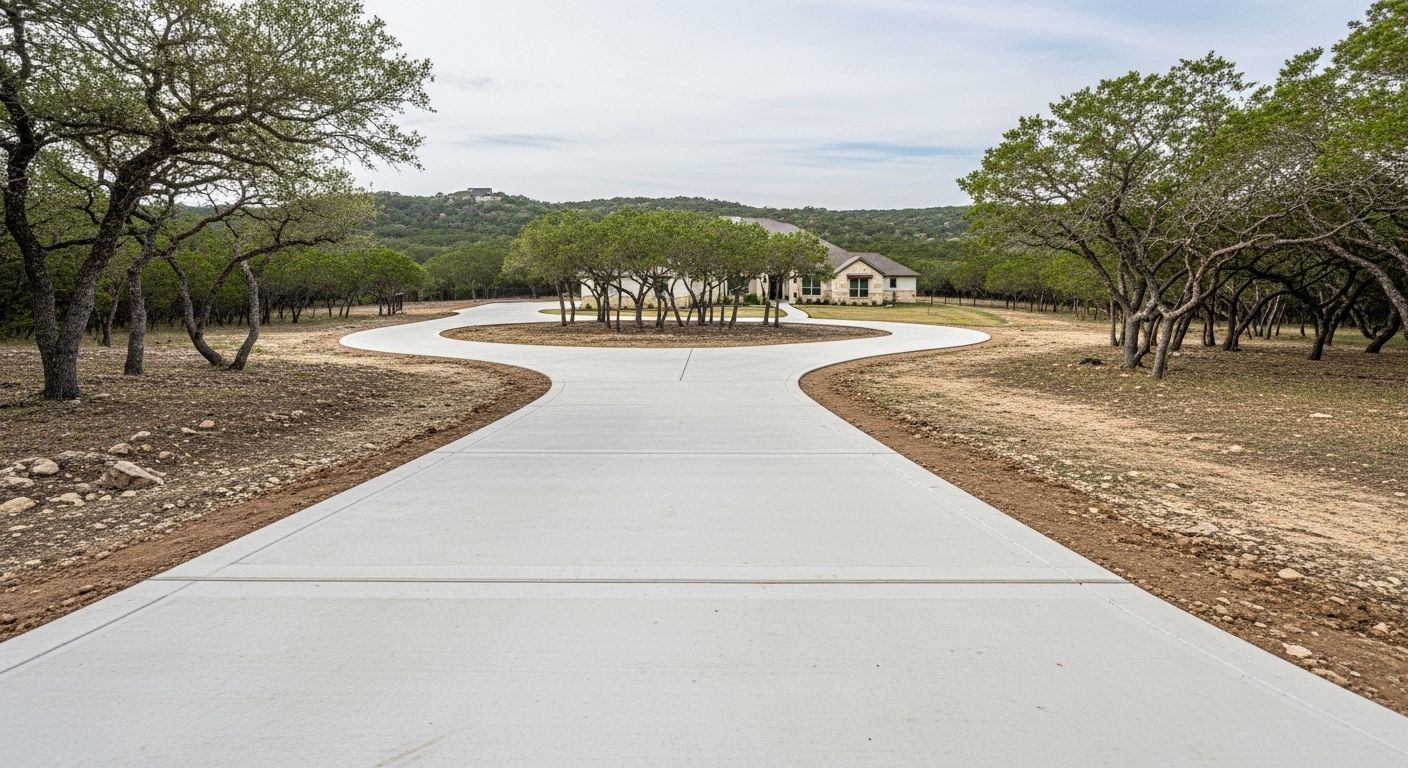
When homeowners in San Antonio, Spring Branch, Boerne, New Braunfels, and the surrounding Hill Country start planning a new driveway, the same question comes up every time: Should I pour concrete, or go with blacktop (asphalt)?
Both have their place, but Hill Country soil, heat, and long-term use change the conversation. If you're thinking about a new driveway or replacing an old one, here's how the two options really compare in our area.
Understanding the Hill Country Environment
Central Texas isn't forgiving when it comes to construction. Expansive clay soils, limestone bases, temperature swings, and heavy rains all put pressure on driveways over time. What works in other parts of the country doesn't always hold up here.
That's why material choice matters more than most homeowners expect.
Key Environmental Factors in Central Texas:
- Expansive clay soils that shift with moisture changes
- Limestone bedrock requiring proper excavation and base prep
- Extreme temperature swings from summer heat to winter freezes
- Heavy seasonal rainfall that tests drainage systems
- Intense UV exposure that degrades surface materials
Concrete Driveways: Built for Longevity
Concrete is often the preferred choice for homeowners across San Antonio and the Hill Country, especially for permanent residences and higher-use driveways.
Pros of Concrete Driveways:
- Long lifespan when properly poured and reinforced — 30-50 years or more with minimal maintenance
- Holds up better to heat and UV exposure — doesn't soften or fade like asphalt in Texas summers
- More resistant to ruts, soft spots, and surface deformation — maintains a level, stable surface over time
- Cleaner appearance that complements modern and traditional homes — enhances curb appeal and property value
- Can be finished smooth or lightly textured for traction — customizable to match your aesthetic preferences
Concrete is especially well-suited for suburban neighborhoods, HOA properties, and rural Hill Country homes, where appearance and long-term performance matter.
Things to Consider:
- Higher upfront cost compared to blacktop
- Requires proper base prep and curing time (typically 7-10 days before use)
- Repairs are less forgiving if shortcuts were taken during installation
When done right, a concrete driveway is a long-term investment that typically outlasts blacktop by many years.
Blacktop Driveways: Lower Cost, Shorter Timeline
Blacktop (asphalt) can still make sense in certain situations, particularly for temporary driveways or lower-budget projects.
Pros of Blacktop:
- Lower initial cost — can save 20-30% on upfront installation expenses
- Faster installation — ready to use within 24-48 hours in most cases
- Easier short-term repairs — simple patches for minor cracks and potholes
However, in Texas heat, blacktop tends to soften, fade, and crack more quickly. In areas like Boerne, Spring Branch, and New Braunfels, where temperatures swing and soils shift, blacktop usually requires more frequent maintenance.
Common Drawbacks:
- Shorter lifespan — typically 15-20 years before major resurfacing needed
- More prone to cracking and surface wear — especially in high-traffic areas
- Requires regular sealing — every 2-3 years to maintain appearance and integrity
- Dark surface absorbs heat — can become uncomfortably hot to walk on and radiates heat near your home
For many homeowners, the savings upfront can be offset by higher long-term maintenance costs and earlier replacement needs.
Real-World Cost Comparison
Initial Installation (typical 20x50 driveway):
- Blacktop: $3,000-$5,000
- Concrete: $4,500-$7,500
15-Year Maintenance & Replacement:
- Blacktop: Seal coating ($400 every 2-3 years) + repairs + potential resurfacing = $3,000-$5,000+
- Concrete: Minimal crack sealing = $200-$500
Total Cost Over 30 Years:
- Blacktop: $10,000-$15,000+ (including replacement)
- Concrete: $5,000-$8,000 (original installation + minor maintenance)
Which Is Better for San Antonio & Surrounding Areas?
For most properties in San Antonio, Boerne, New Braunfels, and the Hill Country, concrete is the better long-term solution, especially when:
- The driveway will see daily vehicle use from multiple cars or heavy trucks
- The home is in an HOA or established neighborhood with appearance standards
- Appearance and resale value matter to the homeowner
- You want fewer repairs and lower maintenance over time
- The property will be a long-term residence rather than a flip or rental
That's why concrete driveways are increasingly common in newer suburban developments and upgraded properties across Central Texas.
When Blacktop Might Make Sense:
- Temporary or short-term driveways on rental or flip properties
- Rural ranch roads or secondary access paths
- Situations where upfront budget is extremely limited
- Properties where you plan to move within 5-10 years
Even in these cases, concrete often proves more economical when factoring in maintenance and replacement costs.
Why Proper Prep Matters More Than Material
No matter which option you choose, the success of your driveway depends on professional preparation and installation. A poorly poured concrete driveway will fail faster than a well-installed blacktop one.
Critical Installation Steps:
- Proper grading and drainage — water must flow away from the driveway and your home's foundation. Poor drainage causes both concrete and asphalt to fail prematurely.
- Solid base preparation — excavation depth, compacted gravel base, and proper slope are essential for stability in Hill Country soils.
- Correct thickness and reinforcement — residential driveways typically need 4-6 inches of concrete with wire mesh or rebar, depending on vehicle weight and soil conditions.
- Clean, professional finishing — proper curing, control joints, and surface finish prevent cracking and ensure longevity.
Skipping steps or rushing the pour leads to cracks, settling, and costly fixes down the road. In expansive clay soils common throughout Central Texas, base preparation is even more critical than in other regions.
Red Flags in Concrete Estimates
Be cautious of contractors who:
- Quote prices without visiting your property for a site inspection
- Skip discussion of base preparation, drainage, or soil conditions
- Don't specify concrete thickness or reinforcement type
- Offer prices significantly lower than other qualified contractors
- Rush the timeline or suggest shortcuts on curing time
- Don't provide references or examples of past work
Concrete Finishing Options for San Antonio Driveways
One advantage of concrete is the variety of finishes available to match your home's style and your practical needs:
- Smooth trowel finish — classic, clean look for modern homes
- Broom finish — light texture for better traction in wet conditions
- Exposed aggregate — decorative stones visible on the surface for a high-end appearance
- Stamped concrete — patterns that mimic brick, stone, or other materials
- Colored concrete — integral color or stains to match your home's aesthetic
These options allow you to create a driveway that enhances your property's curb appeal while still providing the durability concrete is known for.
Additional Concrete Services for Hill Country Properties
Beyond driveways, professional concrete contractors can help with a range of residential and commercial projects:
- Foundation slabs for sheds, garages, and workshops — properly poured and reinforced to support heavy structures
- Patios and outdoor living spaces — create entertainment areas that withstand Texas weather
- Walkways and sidewalks — connect different areas of your property safely and attractively
- Retaining walls and landscape features — manage drainage and create terraced spaces on sloped Hill Country lots
- Commercial concrete work — parking areas, loading zones, and business access
Many homeowners choose to coordinate multiple concrete projects at once to save on mobilization costs and ensure consistent quality across their property.
Planning Your Driveway Project
If you're considering a new concrete driveway in San Antonio or the surrounding Hill Country, the process typically follows these steps:
- Schedule an on-site consultation to assess your property, soil conditions, and drainage needs
- Discuss design options including size, finish, and any special requirements
- Receive a detailed written estimate that includes materials, labor, timeline, and warranty information
- Plan the project timeline accounting for permits, weather, and curing time
- Prepare the site with proper excavation, grading, and base installation
- Pour and finish the concrete with appropriate reinforcement and surface treatment
- Allow proper curing time before using the driveway (typically 7-10 days)
A written, on-site estimate helps set expectations before any work begins and ensures you understand exactly what you're getting for your investment.
Ready to Discuss Your Driveway Project?
Whether you're replacing an old driveway, building on new construction, or upgrading your property, J.B. Woolf can help you understand your options and plan a concrete solution that fits your property and budget.
We serve San Antonio, Boerne, New Braunfels, Spring Branch, and the surrounding Hill Country with professional concrete contracting services.
Request Your On-Site EstimateOr call us at (210) 681-7433
Frequently Asked Questions
Is concrete or blacktop better for San Antonio driveways?
For most San Antonio and Hill Country properties, concrete is the better long-term choice. It holds up better to Texas heat, resists surface deformation, and typically outlasts blacktop by many years. While blacktop has a lower upfront cost, concrete requires less maintenance and performs better in our climate with expansive clay soils and temperature extremes.
How long does a concrete driveway last in San Antonio?
When properly installed with correct base preparation, adequate thickness (4-6 inches), and appropriate reinforcement, a concrete driveway in San Antonio can last 30-50 years or more. The key factors are proper grading, drainage, and curing time during installation. Poor installation can cut this lifespan in half.
Why does Hill Country soil matter for driveways?
Central Texas has expansive clay soils and limestone bases that shift with moisture changes. When clay soils absorb water, they expand; when they dry out, they contract. This constant movement puts pressure on driveways over time. Proper base preparation with compacted gravel and correct thickness is critical to prevent cracking and settling in our region.
How much does a concrete driveway cost in San Antonio?
Concrete driveway costs vary based on size, thickness, site preparation needs, and finishing options. A typical residential driveway (20x50 feet) ranges from $4,500 to $7,500 installed. While concrete has a higher upfront cost than blacktop, the longer lifespan and lower maintenance often make it more cost-effective over time. Contact J.B. Woolf for a detailed, on-site estimate.
How long before I can drive on a new concrete driveway?
New concrete driveways need at least 7-10 days of curing time before you can drive on them. Light foot traffic is usually safe after 24-48 hours, but full strength develops over several weeks. Rushing this process by parking heavy vehicles too soon can cause permanent surface damage.
Do I need permits for a concrete driveway in San Antonio?
Permit requirements vary by location. San Antonio and surrounding cities typically require permits for new driveways or major replacements, especially if they involve changes to drainage or connect to public streets. Your contractor should handle permit applications as part of the project. Always verify local requirements before starting work.
Can I pour concrete in summer or winter in San Antonio?
Concrete can be poured year-round in San Antonio with proper precautions. In summer heat, contractors use evaporation retarders, shade the pour, and may add ice to the mix water to slow curing. In winter, they use insulated blankets and heated water. The best times are spring and fall when temperatures are moderate. Professional contractors know how to work with Texas weather regardless of season.
How do I maintain my concrete driveway?
Concrete driveways require minimal maintenance. Keep them clean with occasional washing, seal control joints every 2-3 years, and address small cracks promptly before they expand. Avoid using de-icing salts which can damage the surface. Most damage comes from poor drainage or soil movement, so ensure water flows away from the driveway properly.
What causes concrete driveways to crack?
Common causes include soil movement, improper base preparation, insufficient curing time, freeze-thaw cycles, and heavy vehicle loads. Control joints (intentional weak points) are cut into the concrete to guide where cracks occur, keeping them neat and controlled. Hairline cracks are normal and don't affect structural integrity.
Can I install a concrete driveway myself?
While DIY concrete projects are possible, driveway installation is challenging for homeowners. The scale, weight, timing, and precision required make professional installation strongly recommended. Mistakes in mixing, pouring, leveling, or finishing can lead to costly repairs. Professional contractors have the equipment, experience, and crew to handle large pours efficiently and correctly.
Does J.B. Woolf offer warranties on concrete work?
Yes, J.B. Woolf stands behind our concrete work with a comprehensive warranty that covers materials and workmanship. We use high-quality materials, follow industry best practices, and ensure proper installation for long-lasting results. Specific warranty details are provided with each project estimate.